






Detect Early Thermal Signs. Prevent Unexpected Failures.
Thermal Imaging Solutions for Mechanical and Electrical Industries
Overview
Mechanical and electrical equipment serves as the driving force behind modern industrial production. From motors, fans, and pumps to compressors, rolling mills, and conveyors, rotating machinery and transmission systems are widely used across various industries. Traditional manual inspections rely on point-by-point measurements with infrared thermometers and experience-based assessments, resulting in low efficiency, limited coverage, and poor data traceability.
The key value of thermal imaging technology lies in enabling inspections without interrupting production. Maintenance personnel can perform real-time thermal scans of critical components such as bearings and gearboxes while equipment remains in normal operation, without shutdowns or physical contact. This overcomes the limitations of traditional temperature measurement methods that require equipment downtime or direct contact, providing a scientific and efficient approach for predictive maintenance and safe operation of mechanical and electrical equipment.
The key value of thermal imaging technology lies in enabling inspections without interrupting production. Maintenance personnel can perform real-time thermal scans of critical components such as bearings and gearboxes while equipment remains in normal operation, without shutdowns or physical contact. This overcomes the limitations of traditional temperature measurement methods that require equipment downtime or direct contact, providing a scientific and efficient approach for predictive maintenance and safe operation of mechanical and electrical equipment.
Bearing Temperature Inspection
Bearing Temperature Inspection
Bearings are critical components of rotating machinery and are widely used in industrial equipment such as motors, fans, compressors, pumps, rolling mills, and conveyors. During operation, bearing heat is mainly generated by friction, insufficient lubrication, or internal damage. Abnormal bearing temperatures often serve as early indicators of equipment failures, including poor lubrication, increased friction, and bearing degradation.
Pain Points
- Point-by-point measurements with infrared thermometers are prone to missed detections.
- Equipment failures often develop gradually, while the lack of historical data makes trend analysis difficult.
- Manual inspections pose safety risks in harsh environments such as high temperatures, dust, and high-pressure conditions.
.jpeg)
.jpeg)
Solution
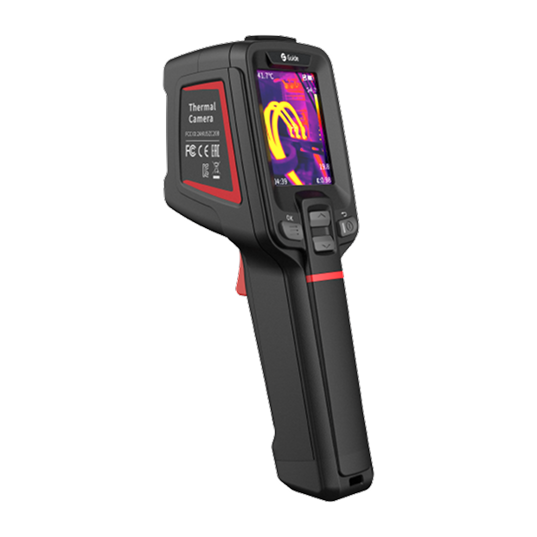
Handheld thermal cameras can be used to inspect bearing components in motors, fans, pump systems, and other industrial equipment. In addition to displaying the maximum bearing temperature, thermal imaging reveals whether the temperature distribution is uniform. Under normal conditions, bearing thermal images show smooth temperature gradients. When wear or insufficient lubrication occurs, distinct “hot spots” appear, indicating potential equipment issues.
Area-based inspection: Provides complete temperature distribution, improving inspection efficiency.
Safe inspection: Enables non-contact inspection without equipment shutdown, even during normal operation.
Early warning: Detects abnormal temperature changes at the early stage of faults to prevent failures before they occur.
Transmission Equipment Inspection
Background
Gearboxes are the core components of power transmission systems. Internal gears operate under high-speed and heavy-load conditions for extended periods, making lubrication conditions, gear wear, and bearing performance critical factors that directly affect gearbox service life and operational reliability. Gearbox and differential housings are sealed and opaque, making internal conditions impossible to inspect visually.
Pain Points
- Sealed housings block visibility, making internal conditions impossible to observe.
- Deployment of contact sensors requires equipment shutdown.
- Manual assessment is subjective and inefficient.
.jpeg)
.jpeg)
Solution
Thermal cameras can quickly visualize the temperature distribution on the gearbox housing surface, enabling intuitive assessment of internal lubrication conditions and gear meshing performance. The system can set temperature thresholds and automatically trigger audible and visual alarms when the surface temperature exceeds the preset limit, alerting maintenance personnel to take timely action.
“See through” sealed housings: Assess internal lubrication conditions and gear status indirectly through surface temperature distribution.
Inspection without downtime: Perform comprehensive scans while the gearbox remains in operation, without interrupting production.
Rapid large-area screening: Scan the entire gearbox housing in a single inspection, with temperature distribution clearly visualized.
Inverter Thermal Dissipation Performance Testing
Background
Inverters are critical power electronic devices widely used in photovoltaic systems, electric vehicles, and energy storage systems, responsible for converting DC power into AC power. Failures such as cooling fan malfunction, clogged heat sinks, and thermal path design issues can lead to localized heat accumulation. These problems not only reduce conversion efficiency but may also cause severe failures, including IGBT explosions and drive board carbonization.
Pain Points
- Cooling performance is difficult to evaluate visually.
- Early-stage thermal issues are difficult to detect.
- Heat dissipation design defects are difficult to diagnose.
.jpg)
.jpeg)
Solution
Thermal cameras can clearly visualize the temperature distribution across different parts of the cooling system. By comparing temperature differences between components within the same inverter or analyzing thermal patterns among multiple inverters of the same model, it can quickly evaluate whether the cooling performance meets requirements. Inspection data can establish a closed-loop management process of “inspection data collection → thermal analysis → performance evaluation → maintenance decision-making,” providing data support for cooling system maintenance and design optimization.
Design optimization: Thermal image data helps diagnose cooling design defects and provides a basis for improving thermal management solutions.
Inspection without downtime: Evaluate inverter cooling performance comprehensively while the inverter remains in operation.
Early warning: Detect potential issues at the early stage of cooling efficiency degradation to prevent overheating damage to power components.

.png)
.png)
.png)
.png)