


How to Choose a Thermal Camera for Smartphone: A Complete Buying Guide


Smartphone thermal cameras transform your phone into a portable thermal inspection tool, suitable for detecting temperature variations and identifying thermal anomalies in electrical components, HVAC systems, buildings, vehicles, pipes, household equipment and even for detecting wildlife, lost pets, and hidden heat sources in the environment. However, these cameras are not all the same; factors such as resolution, temperature range, connection type, software, size, and measurement functions all affect the actual inspection experience.
Before making a purchase, it is crucial to understand which features are essential for your work.
Check the Thermal Resolution
Thermal resolution should be one of the primary specifications you compare.
Higher thermal resolution means the thermal camera can display more thermal pixels, making it easier to distinguish small objects and identify temperature patterns.
For basic home inspections, a smartphone thermal camera with lower resolution may be sufficient; however, for professional inspection work, a higher-resolution model can provide more useful thermal details. And some device has the real-time super-resolution will also help to enhance image clarity and reveal finer thermal details.
However, do not choose a thermal camera only based on the number of pixels, as image processing capabilities and lens performance also affect the final thermal image.
Consider the Temperature Measurement Range
Different applications require different temperature ranges.
If you are mainly using the device to inspect walls, air conditioning systems, or household equipment, an extremely wide temperature range is usually unnecessary.
However, if the device is intended for industrial applications, electrical components, machinery, or high-temperature targets, you may need a smartphone thermal imaging camera with a wider temperature measurement range.
Be sure to verify the actual temperature measurement range before purchasing rather than assuming every thermal camera can measure the same temperatures.
Look at Thermal Sensitivity
Thermal sensitivity refers to a thermal imaging camera's ability to detect small temperature differences and is commonly expressed as Noise Equivalent Temperature Difference (NETD). A lower NETD generally indicates better thermal sensitivity.
This is particularly important when the temperature difference between two areas is very small. Cameras with better thermal sensitivity can provide more useful information when detecting subtle thermal changes.
For instance, minute temperature differences can be critical when inspecting insulation, electronic components, or HVAC systems.
Therefore, thermal sensitivity should be considered together with resolution.
Check How the Camera Connects to Your Phone
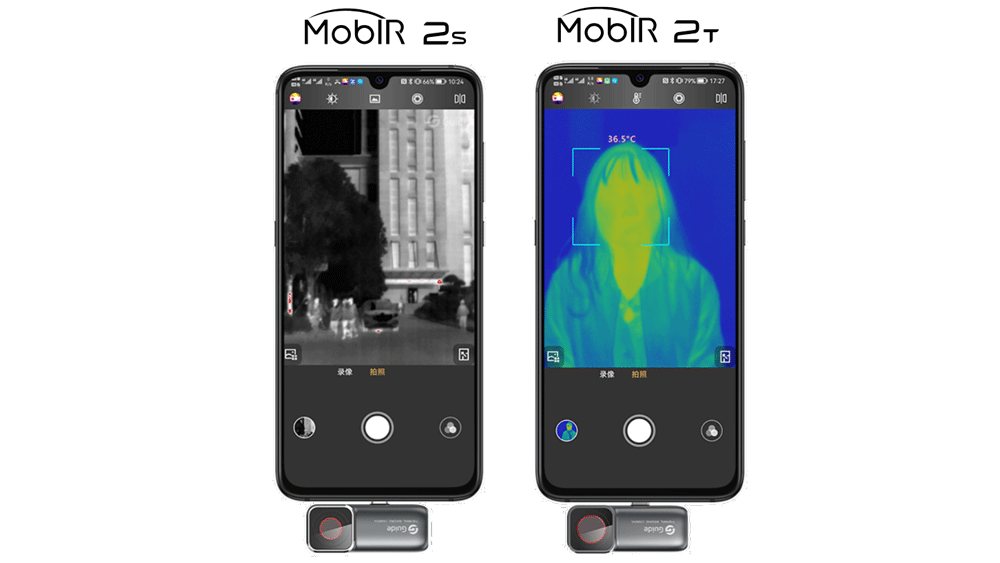
Smartphone thermal cameras usually connect directly to the phone via a physical connector or other supported connection method.
Before buying, be sure to verify that the thermal camera is compatible with your smartphone.
You should also check whether it supports your phone's operating system and port type. You’d better choose the smartphone compatible with both iOS and Android. And then you don’t need to worry if you change the phone. The thermal camera for iOS and Android is your better choice.
A technically good thermal camera is not very useful if it cannot connect properly to your device.
Focus on Thermal Imaging Apps
Mobile apps are a crucial part of smartphone thermal imaging cameras.
A high-quality thermal imaging app should allow users to easily view images, select the thermal palette, select temperature measurement points, and save inspection results.
Useful features may include:
l Spot temperature measurement
l Tracking of maximum and minimum temperatures
l Thermal image adjustment
l Image and video recording
l Report or file sharing
l Temperature area analysis
For regular inspection work, easy-to-use software can save more time than an unnecessarily complicated interface.
Choose the Right Size for Your Work
A major advantage of smartphone thermal cameras is their portability.
Compared to large handheld thermal cameras, these smartphone attachments are easier to carry in a pocket, tool bag, or backpack.
This makes it useful for quick checks during maintenance work.
If you frequently move between different locations, a compact thermal camera can be more convenient than carrying a larger inspection device.
Consider the Detection Distance
The lens is also crucial when choosing a smartphone thermal camera.
A wide-angle lens may be suitable for inspecting large areas, while a narrower field of view can help users examine smaller targets from a greater distance.
For example, inspecting a large wall and examining a small electronic component are two very different tasks.
When choosing a thermal imaging camera for your smartphone, consider the size of the target, the typical shooting distance, and the camera's field of view.
Consider Image Quality in Real Working Conditions
While specifications are important, actual imaging performance is even more critical.
A thermal imaging camera should provide thermal images that are easy to understand under normal inspection conditions.
Focus on image stability, clear thermal patterns, useful measurement information rather than focusing only on marketing terms.
If possible, compare actual thermal images captured by different models before making a decision.
Check Measurement and Analysis Features
A smartphone thermal camera is more useful when it provides practical measurement tools.
Depending on the specific model, you may be able to set temperature measurement points for specific areas, hot and cold spots, compare different regions, or adjust the temperature scale.
These features are particularly valuable when a thermal camera is used for equipment inspection and maintenance rather than simple temperature checks.
Choosing a Thermal Camera Based on Application Needs
The best thermal imaging camera for your smartphone isn't necessarily the one with the highest specifications.
Think about what you will inspect most often.
For example:
l Home inspection: focus on temperature range, image clarity, and simple operation.
l HVAC inspection: pay attention to temperature measurement and thermal sensitivity.
l Electrical maintenance: prioritize image detail, measurement accuracy, and the convenience of image recording.
l Automotive inspection: Consider portability, temperature measurement range, and close-up imaging.
Matching the camera to the application can prevent you from paying for features you rarely use.
Conclusion
Choosing a smartphone thermal camera should start with your actual inspection needs.
Focus on key specifications such as thermal resolution, temperature measurement range, thermal sensitivity, lens performance, smartphone compatibility, software features, portability, and measurement capabilities.
A well-equipped and compact thermal camera for smartphone is suitable for both quick home inspections and professional maintenance.
Do not blindly pursue the highest specifications. Instead, choose a smartphone thermal imaging camera that best suits your inspection targets, measurement requirements, and working conditions.
(1).jpg)